
Alt-Neu sound of Jewish culture
Museum of Jewish Art and History in Paris presents first ever exhibit dedicated to 'Radical Jewish Culture' – musical current stemming from highly prevalent Jewish culture of New York’s 1980s,1990s underground scene
Yonith Benhamou, Daniel Benedikt
פורסם: 21.06.10, 08:54
It all started in Munich, 1992. In the same city in which Nazism was born, during the evocatively-titled "Festival for Radical New Jewish Culture". John Zorn, a talented composer and saxophonist, brought together major Jewish musicians of the New York underground scene to play one of his compositions, "Kristallnacht," in remembrance of the pogroms orchestrated by the authorities of the Third Reich on the night of November 9th, 1938.
This event was a landmark for the cream of musicians such as Lou Reed, Marc Ribot and Frank London, performing in a powerful dramatic atmosphere. Breaking with the norm, they played a musical fusion involving free-form jazz with Klezmer improvisations, Hitler’s speeches, and sounds of broken glass.
“1992 is a pivotal year. The idea is to make them play (...) not a ‘Jewish’ music, but their own music, which is a trailblazing music, a new music in a certain way, saying something of their Judaism”, comments the exhibition’s curator, Mathias Dreyfuss.
It was a time when these New-York Jewish musicians, versed in the contemporary music of the day, rediscovered a musical Jewish history from Eastern Europe: Klezmer: “I did not grow up with Klezmer. There is no continuity. What has been portrayed as continuity, is in fact a radical disruption”, explains Marc Ribot, an actor with the exhibition.
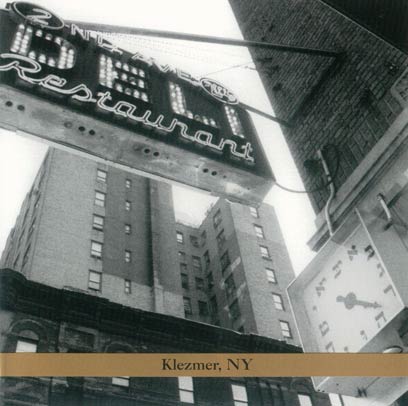
Cover of David Krakauer album, 'Klezmer', NY (Photo: Tzadik, 1998)
The exhibition, taking place in Paris, an area of great Jewish history in its own right, attempts to explore and explain this ‘radical disruption’, asking questions such as what is Jewish music today and how can Jewish culture and music be modernised, without betraying its history?
John Zorn, creator of the Radical Jewish Culture, created his record label, Tzadik, for this very reason. Created in 1995, the label released avant-garde and experimental music, exploring these questions, and providing answers by way of a diverse plethora of albums.
If the atypical exhibition, fails to use a traditional museum-based approach to introduce Radical Jewish Culture, it retraces with success the connection which brings together its various components; it places music as the central attraction.
“This is the first musical exhibition of the Museum. Artists, who are still alive, are usually exhibited in galleries or in museums of contemporary art. Here, it is about a new take on the link between music and History and Jewish culture”, explains Dreyfuss. In order to demonstrate this, the Museum houses a series of exceptional concerts, with some of the biggest names of the radical Jewish Culture movement of today: John Zorn, Anthony Coleman, Mark Feldman, to name but a very few.
Where ‘new’ and ‘old’ meet perfectly
The exhibition allows the public to explore, discover and listen to key turning points of the movement; it also brings to light the influences on the musicians themselves. The work of the two major icons of the Beat Generation, the artist Wallace Berman and poet Allen Ginsberg, author of the poem Kaddish, have also served as creative roots for movement’s artists.
It is where ‘new’ and ‘old’ meet perfectly; a projection towards the future as well as a return to basics, a combination of rupture and continuity. The genesis of this artistic movement is the result of artists' quest for their Jewish roots, producing creativity by way reinvention.
As John Zorn states, “Radical Jewish Culture is everything at the same time: a musical current, a movement with diverse political resonances asserted and assumed, a musicians’ community, and more widely, an aesthetic community”. For Zorn, radicalism is, above all, a claimed aesthetic. “They are researchers, experimenters. It is a question of showing that the musicians who get involved in their art exceed the simple journalistic frame; they have a very strong aesthetic identity”, explains Dreyfuss.
But this exhibition displays that every musician has his own definition of ‘radicalism’. For some, it is linked to politics, supporting peace in the Middle East. For others, it is this return to traditional music, to their Jewish roots.
It would seem that there exists an intrinsically Jewish musical aesthetic, a music combining self-derision, and self criticism, now at ease with itself, aiming to re-appropriate Jewish culture as well as to revitalize it by means of sound as cosmopolitan and Jewish as New York itself.
Exhibition, “Radical Jewish Culture: scène musicale New-York”, until July 18th, 2010. 71, rue du Temple, 75003 Paris