
Israelis at heart of London music scene
Having just played klezmer in park festival as well as string of summer dates across London Venues, Daphna Sadeh and Voyagers about to perform another date in UK before getting into involved and reclusive process of writing and composing for next release
Gil Karpas
פורסם: 05.10.10, 13:03
The United Kingdom is a multi-cultural melting pot for the arts. It is a place where styles from around the globe find sanctuary and develop new fusions as they interact with others within a dynamic, vibrant and fertile arts scene. This reflects the diversity, tolerance and cohesion that makes British society what it is today.
London is the epitome of this diversity, providing a patchwork of forums for expression across communities, in all manners of venues and to an array of audiences. It is this city that has for some time been a space where Israeli musicians have come to express, explore and expand their musical minds. Some come on a quest for fame and fortune, others to escape Middle Eastern politics and some simply arrive as a matter of unintended consequence.
There are classical virtuosos, singer-songwriters, jazz players and DJs aplenty around the capital but it's the world music musicians that spring so vividly to my mind. Those who are out of their borders, yet bring with them the heady musical cocktail of their diverse backgrounds. In other journalistic roles I have interviewed world class musicians such as the acclaimed Israeli singer Mor Karbasi, who has been gaining an international reputation as a gifted singer and part of the resurgence of Ladino song, alongside bands such as Los Desterrados and singer Yasmin Levy.
I have also had the pleasure of talking with multiinstrumentalist virtuoso Koby Israelite, whose eclectic and original sound is a fusion of punk, heavy metal, balkan and klezmer and whose work has been used for film scores, including for the soundtrack to Madonna's directorial debut.
I speak to Israeli band leader, composer and bassist, Daphna Sadeh about her experiences and explore what it is to be Out of Border and musically rooted in a middle eastern frame but in a western place.
She and her band The Voyagers are signed to the infamous and innovative New York record label; Tsadik. A regular fixture on the London scene, she has played the Royal Festival Hall numerous times, as well as performed at countless festivals across Europe and venues throughout the UK.
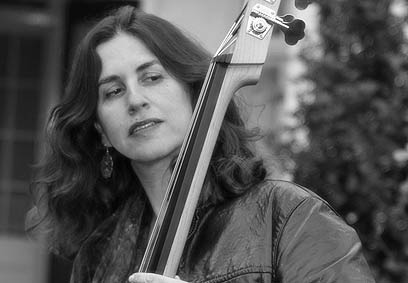
'Each Album is like a chapter in my life.' Daphna Sadeh (Photo: Haim Alganati)
She is renowned for working with musicians across cultural lines in search of musical connections travelling along the spectrum of interlinked genres, melodies, rhythms and styles. Palestinian musician George Samaan and Kurdish singer Navroz Oramari have worked numerous times together with Daphna in a spirit of amity and this symptomatically underlines the connectivity between cultures through common artistic heritage.
It is the question of heritage that in many ways separates “world music” from other genres. To my mind, World music is much like a national carrier airline whereas pop music from anywhere is more like a budget airline. It's functional at best and indistinguishable but by language and doesn't serve up many interesting or original flavors, on the whole something pre-produced and generically packaged.
Having arrived in the UK in 2002, with the raw master recordings of an album she set about the unenviable task of setting up a new life. The album itself had been recorded in Israel with both Jewish and Arab artists featuring on it, Daphna reflected; “it proved to be very intense and emotional as it had been recorded during a period when there was heightened phase of conflict”. The end product was “Out of Border” and it is a very emotional, reflective and thoughtful body of work, that on release in the UK immediately started to turn heads in the world music scene, landing her an interview on the late great DJ Charlie Gillett's BBC London radio show.
“Each Album is like a chapter in my life. Probably the next chapter will be quite different. In fact I want it to be different. My first album was an expression of my leaving Israel and experiencing that feeling of the bewildering unknown."
Multiculturalism
It was after having been in the UK for a year or so that Daphna started to see how the artistic elements of both societies compared.
“There are some similarities and differences between the UK's multiculturalism and Israel's. The similarities are that there is one main religion alongside a diverse set of backgrounds. In Israel this cultural wealth and their respective diversities provide that multiculturalism. However in the UK it is actively facilitated by organizations such as the Arts Council, artistic agencies and other cultural foundations.”
The second album was about her discovering her new band, The Voyagers. “I was looking for them. I had made some serious research about what musicians with Jazz and World music skills were in the UK and after meeting, jamming and talking with lots of different musicians, the band just fell into place”
With that “Walking the Thin Line” was produced, it's a story of travel, with journeys between not simply geographical societies and the ideas of countries of sound but more so about a state of being. The thin line between belonging and not belonging. With this release the notoriety grew and the band received more rave reviews with the gig offers around the UK and Europe flying in.
By the time that John Zorn had signed Daphna and the Voyagers to the avant garde and dynamic Tsadik record label and released “Reconciliation”, the band were widely recognized with a work that was celebrated by the world music press and media.
Now, having just played the Klezmer in the Park festival as well as a string of summer dates across London Venues, Daphna is about to perform another date in the UK before getting into the involved and reclusive process of writing and composing for her next release.
Without giving too much away, Daphna hints “it's going to be more eclectic World music with Jazz and Funk and less of klezmer. It's not to say that my background and the colors I always instinctively brought to my music won't be there, it's just that I always have to strive in a direction that takes me to a horizon. The musical vista when I get to it will be different, even though its still me the music will be the new place I embrace.”
Daphna plays her last UK date of 2010 at The Junction Theatre in Cambridge on Wednesday, October 13. More info here http://www.junction.co.uk
- Follow Ynetnews on Facebook