


Who’s waiting for Assad?
Talk of Syrian peace overtures meaningless
The recently used phrases “Syria wants to negotiate with Israel,” “Syria is signaling its desire to renew talks where they left off,” “Damascus is ready to talk without preconditions,” “Syrian President Bashar Assad is ready” and “They have made a strategic decision to take the political route and reach an agreement” may sound like they came out of Syrian fortune cookies, but they never made it out of Damascus.
They are part of an Israeli ritual.
Like an occurrence of finding life on Mars or traces of natural oil in Israel, for more than 10 years and once every few months, a ray of light shines from Damascus and sweeps the imaginations of Israeli politicians and analysts.
The conclusion is usually decisive: We must find the chance - it’s nationally and diplomatically irresponsible not to react to encouraging messages. We cannot seem uncooperative. Peace with Syria would deeply change Israel’s geopolitical situation. And regardless, what do we have to lose?
Sometimes this includes officers or participants from one of the former rounds of negotiations, businessmen and independent messengers, who met one of the sons of former Syrian Defense Minister Mustafa Talas in Paris, or the accountant of Rifat Assad - the brother of late President Hafez Assad - in Geneva.
This sometimes includes those on the national level, perhaps the Israeli foreign minister, who look for free headlines without content, continuity and responsibility.
The majority rules that it is all an unsuccessful attempt to divert attention from the heart of the Israeli interest: Negotiation and separation from the Palestinians.
For the past two years at least, these decisions have been amazing in their
disconnection from regional and geopolitical reality, and especially the U.S. policy.
The United States put Syria on the list of nations that aid terror. The “Syrian Responsibility Act,” passed by Congress, places sanctions on it for its support of terror, arming of Hizbullah and the continuation of its presence in Lebanon - which has ended, at least formally.
President George W. Bush keeps saying that Washington will continue to monitor Syrian activities that promote instability in Lebanon.
Harmful statements serve no purpose
But all this does not hinder the Israelis from continuing the “We must find a chance” nonsense. The price is clear, and the Israeli government is not ready, willing or able to pay it.
One can also claim, justifiably, that there is no strategic benefit in negotiating with Syria right now. So what’s the point of the game? What is the political achievement?
About 80 percent of the Syrian population – 18.5 million people – are under
the age of 35. Thirty-six percent are under the age of 14. The unemployment
rate there is creeping toward 20 percent and the economy is weak. Its gross
domestic product stands at between USD 1,100 and USD 3,000, as opposed to
more than USD 17,000 in Israel.
The Alawite Syrian regime is weak, even if it is stable, and potential sources of power and support are nonexistent as long as Syria is isolated, it’s hold on Lebanon isn’t what it was, its military inferiority against Israel is decisive, America is in Iraq, Europe is thrilled by the bells of freedom in Lebanon and Russia isn’t selling weapons to the extent and quality the former Soviet Union did.
In 2000, at Shepherdstown, West Virginia, former Israeli Prime Minister Ehud
Barak signaled Israel’s willingness in principle to fully withdraw from the Golan Heights and opened up for negotiation the precise borders around the Sea of Galilee, control over the water and security arrangements.
In return, he asked for full peace, normalization and a symmetric demilitarization. At the end of the day, Syrian President Bashar Assad turned it down.
Then-President Bill Clinton understood it as well. So the basic question is: If Israel does not want to pay the fixed price for a permanent agreement with Syria, or does not see the benefit in doing so, what are the harmful statements for?




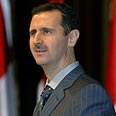
Don’t count on Assad, Alon Pinkas says
צילום: רויטרס
מומלצים

