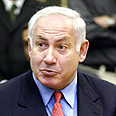
'Key in Netanyahu's hands'
Finance Minister has plenty of reasons to stall his decision regarding pullout's postponement
Prime Minister's Office Director-General Ilan Cohen turned to Knesset Finance Committee Chairman Yaakov Litzman this week. The committee was discussing a Finance Ministry proposal to award every Israeli citizen a small package of Bank Leumi stock.
"(Prime Minister Ariel) Sharon is against the idea," Cohen told Litzman. "Please don't vote on it."
Litzman is stuck. Two different Israeli governments have asked him to do two different things, and he had a hard time figuring out which government he should respond to. Eventually he decided to comply with Finance Minister Benjamin Netanyahu's government.
A silly system of cronyism will be set up in the Finance Ministry to hand out beads to the Indians. Meanwhile, Netanyahu upgraded the law that provides tax breaks to towns located near Gaza to compensate residents living within the Qassam rocket range. Sharon's Sycamore Ranch will most likely also benefit from the law.
At the last minute Netanyahu added a number of Likud Party-affiliated development towns to the list of towns that stand to benefit from the law. The amendment was approved despite Sharon's objection, but the High Court will annul it.
The story here is not Netanyahu's sudden burst of compassion, nor is it the bitterness between him and Sharon, which, unlike wine, does not improve over the years.
'The time is now'
Netanyahu is facing one of the most critical decisions of his life. He, and only he, can attempt to thwart the disengagement through political means, and there is intense pressure on him to try and do so. He is conveying mixed messages. He is unclear. He is weighing the possibilities.
To a certain minister he says one thing, and to another minister he says something else. On Tuesday he flew to the U.S., a temporary sanctuary from the decision he is having trouble reaching.
Just joking
Currently the dilemma is focusing on the proposal submitted by Zevulun Orlev (National Religious Party) to postpone the pullout. When the Ministers' Committee on legislation discussed the proposal, it was treated by the ministers as a harmless nuisance, a joke almost. Why, the Knesset has already decided on the matter.
But the orange ribbons filled the streets, and Netanyahu held a series of talks with anti-pullout activists.
"I will act in due time," he promised.
"'Due time' has already passed," one of them responded. "The time is now."
He quoted the biblical story of Ester, in which Mordechai tells Queen Esther, "It is for just such a time that you became queen," and implored her to use her royal influence to persuade King Achashverosh to reverse the death sentense Haman had passed on all the Jews of Persia.
Netanyahu has hinted that he is considering supporting a postponement following the completion of the evacuation's initial phase.
Has his beloved businessmen to consider
People will be forcefully dragged out of their homes, toddlers placed in tents, thousands of protesters arrested; TV screens will be filled with visions of violence, weeping, and, perhaps, terror attacks as well. Then, when the trauma reaches its climax, Netanyahu will propose a time-out for reassessment. Three months, no more. For our children's sake.
Orlev will submit his proposal to a Knesset vote. If Netanyahu support it, ministers Yisrael Katz, Danny Naveh, Tzachi Hanegby, and Limor Livnat will feel a desperate need to follow suit. And, of course, Silvan Shalom will also fall into line. Pro-pullout Knesset members, such as Yuval Shteinitz, Yaakov Edri and others will reconsider their positions.
Regardless of the Knesset vote results, Sharon's government will collapse, as it would not withstand the resignation, or firing, of six of its ministers.
In other words, the pullout's postponement means early elections.
"The key," Orlev told me on Tuesday, "is in Netanyahu's hands. Only he can do it."
While this statement is complementary in nature, it also holds a threat: Soon-to-be prime ministers do not want to be perceived by the public as people who have toppled governments that preceded them. The toppling of a government is an act that is too extreme, too dirty and too controversial. It is better left to others.
Then there is the world. What will the international community say about a man who has thwarted a move that America and Europe have invested so much in? And what will Netanyahu's beloved businessmen say? And who will the average Israeli blame in the aftermath of the next terror attack?
No wonder Netanyahu is hesitating.