'Our tears in his poems'
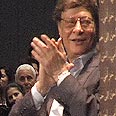
(VIDEO) Palestinian poet Mahmoud Darwish returned to Haifa Sunday night and read his poems in front of hundreds of cheering fans. This is a rare opportunity to listen to him, for those who were not there

Darwish reading his poems (Arabic)
Others were vying for tickets, trying to at least gain entry to the second hall where the national Palestinian poet was simultaneously shown on a big screen, reading his poems in the city of his birth.
Sitting side by side in the front row of the auditorium hall were Hadash Party leaders Muhammad Baraka, Dr Hana Suwayd, Isam Mahul, and Ayman Udah. Fidgeting right next to them was Dr Ahmad Tibi, Ra'am-Ta'al Party member. Photographers from Al-Jazeera, PBS, CNN, and European TV stations positioned their cameras and were clicking and flashing away. Amal Murcus, the narrator, asked the audience to be patient. "It will take just a little while," she said with a smile that the crowd cheered lovingly.
Glad to be home
It has been almost 40 years since Darwish left his homeland and went to study in Moscow. With time, he made his home between Amman and in Ramallah, but visited Haifa periodically. Some 10 years ago, he came for the funeral of his friend, Emil Habibi, and attended literary gatherings held over the years in Nazareth, Kafr Yasif, and J'deydeh. Nevertheless, his current visit - sponsored by Mashraf, a periodical edited by Siham Daud and founded by Habibi and Hadash - was different for Darwish. Despite the power struggles between the supporters of Hadash and the Balad members, the poet was simply looked glad to be home, surrounded by his admirers."I am going to my city, not to the Knesset," he answered Pierre Abu-Sa'ab, editor of the culture section of Al-Akhbar magazine, who criticized his decision to appear in Haifa with the permission of the Israeli authorities. Darwish's city received him with teary eyes and loving hugs. When he went on stage, he paused to savor the moment, gazing at the crowd that gave him a standing ovation. He signaled for them to sit down and said modestly: "Please, do not make my visit a special event. There is no need to make a fuss about my arrival at a place that is only natural for me to be in."
He addressed the situation in the territories and expressed his displeasure with the gap created between Gaza and the West Bank. "Instead of building a state alongside Israel, you are building a state within a state," he said.
He read from his collection of poems, "Almond Flowers or Farther," from "Fresco," and from "Why Did You Leave the Horse Alone?" He read out "I am Yusuf, My Father" and "Longing for My Mother's Bread" which has become a symbol. Often viewed as aloof, distant, and vain because of his natural shyness, Darwish stood onstage proud, relaxed, and loved his audience right back. His words rolled out of him like music. "I am my language, this is my language," he said and offered it as a present to the audience. Later he even remarked: "It was a special evening. An unusual atmosphere was created in the hall."
A people's evening
Even the politicians in the audience were left breathless when the evening ended. "We were floating at heights we rarely visit in the bleak routine life we are living," said MK Muhammad Baraka. "Darwish is an artist of the simple words. For us, the Palestinian people, to see the man who left us and returned to us is a special event."
Baraka was also moved by the huge public response. "We should be proud that despite the shallow empty shells of the consumer life so many people made the effort, came here, and sought to soar into a world of sublime and singular creation." Conspicuous in his absence last night was Culture Minister Ghaleb Majadla. His ministry staffers refused comment, but said off the record that the minister was displeased with the political nature of the event.
On his part, Baraka said: "We did not want to make it a stately, official visit. We have nothing against Majadla, but we felt that the presence of a cabinet member could have given the evening a different flavor. Muhammad Darwish is above politics and this was a people's evening."
Long after the event ended, large groups of people still stood in and outside the hall. Miriam and Sima, two Technion students, came to see Darwish despite facing a final exam the next morning. "It was important for us to be here. It was a rare occasion because you never know when he will visit again, if at all," they said. For them, Darwish is a role model. "We both write poetry and Darwish's work influenced us a lot. Like him, we also hope that the Jews will read our poems."
Outside the hall stood two young men, donning kaffiyehs. Ja'ber Basal and Halil Sa'id from the village of J'deydeh came all the way to Haifa even though they are in the middle of their matriculation exams. "We managed to buy the last tickets" they said satisfied, "which was not easy."
Teenagers do not always let their feelings show, but Darwish made them weep. "When he read his last poem, the one he dedicated to his mother who lost here eyesight with crying out for him, I just wept," Sa'id said. "Many read his poems, but to hear him is altogether different." "He is our spirit, our soul, our tears are in his poems," said Ja'ber. "His power comes from love of the homeland and this nation. For us, Darwish is so much more than Harry Potter, which everyone reads."