






Dangerous nights
Local nightlife scene plagued by violence; club owners say they are helpless
TEL AVIV - Israel's lively nightlife scene is becoming increasingly synonymous with drugs, heavy drinking, and violence, officials and club owners say.
"The situation keeps deteriorating," says a police officer who declined to be named. "It's a miracle that we don't see 10 or 20 people killed every night."
It seems virtually all nightclub revelers use drugs or alcohol nowadays, he says, as evidenced by the hundreds of drunk and high partygoers wobbling away from the Tel Aviv port entertainment district every Saturday morning.

מועדון האומן 17 אומן 17 ירושלים דיסקוטק (צילום: יהונתן דייויס)
Large-group violence
Recent murderers outside local clubs did not come as a surprise for club owners. Many of them say the youngsters who frequent clubs have become increasingly violent and dangerous.
"They come not only to dance, but to make a mess," said one club owner who asked not to be identified.
Despite the increasing violence, club owners cannot be expected to be held accountable for what takes place outside their venues, says Haim Pinchas, who owns popular Tel Aviv clubs Vox and Dome.
"I cannot provide security for the entire compound," he says. "The police should boost patrols outside clubs."
The most problematic crowd consists of soldiers and youngsters about to be drafted into the army, Pinchas says, and adds that members of this age group (roughly 18 to 21) may be legally entitled to buy alcohol, but are still too young to handle it.
"This is the crowd that scares me the most when I throw a party," he says.
Pinchas, however, dismisses talk of a connection between the increased violence and the large immigration waves from the former Soviet Union.
"I salute the Russians, because they know how to drink," he says.
Most problems are related to hot-tempered Israeli-born revelers who come in big groups, Pinchas says.
"If there's a problem with one of them, his friends come and throw bottles at the club," he says.
Public relations representative Shahaf Segal, who is a self-professed party animal and former nightclub security guard, says she is familiar with large-group violence.
She says a youngster was murdered by a rival gang outside a Tel Aviv club last year while she was celebrating her 34th birthday inside.
"They killed him without using knives or a gun," she says. "They simply bashed his head against the floor until his brains spilled out."
Segal says she does not wish to assign blame, but adds that she is convinced today's youngsters are more prone to violence than previous generations.
"I know I sound like a 100-year-old aunt when I say this, but today's youngsters are very violent," she says.
Club owners invest great efforts in providing security inside clubs, Segal says, but they cannot be expected to prevent all the violence, particularly when it takes place outside the venue.
"If my husband murders me in a rented apartment, would my landlord be held accountable?" she says.
Police say they are shorthanded
The surging violence throughout Israeli society is to blame for the growing violence at clubs, says Reuven Lublin, who owns popular Jerusalem nightspot Haoman 17. There have not been any stabbing incidents at his club in the past 10 years, he says, but the violent mood is very much there.
"You can feel it in the air, in the way they talk," he says.
Security at the club is tight, Lublin says, but adds that a troublemaker does not need to bring in a knife in order to cause damage.
"He can just grab a beer bottle and smash it on someone's head," he says.
The police say they are aware of the problem and are investing great efforts in addressing youth violence. The increasing violence, however, is only a symptom of the real problem, namely alcohol consumption, says Suzy Ben-Baruch, who heads the police's juvenile crime section.
"Most violent incidents involving youngsters are committed under the influence of alcohol," she says.
Undercover police officers are sent into clubs to enforce liquor laws, says Ben-Baruch, while traffic police look for drunk drivers near entertainment districts. She admits, however, that those measures are insufficient.
Only a systematic, comprehensive effort can effectively combat the problem, she says, and points to the crisis in the education system, the collapsing welfare system, and a police manpower shortage.
"We try to address the problem with the tools we have," she says.
- Amir Ben-David contributed to this article




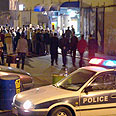
Police outside Haifa club
צילום: סבסטיאן שיינר
מומלצים

