
The ongoing war has presented significant and unprecedented challenges for Nefesh B’Nefesh. Despite the widespread rocket attacks across the country and the uncertainty of the local situation, the 23-year old organization never considered pausing its activities, even as Israel faced an indefinite state of emergency.
"It has undoubtedly been a challenging time, but we’re incredibly proud of what we achieved this past year", says Rabbi Yehoshua Fass, Co-Founder and Executive Director of Nefesh B’Nefesh. "We navigated the situation by focusing on four key areas simultaneously: first, by maintaining our regular projects and providing essential services to our communities, Olim, and Lone Soldiers; second, by leveraging the organization's strengths to assist the State of Israel during this difficult time; third, by addressing the surge in Aliyah requests from North America; and lastly, by building a long-term strategy while remaining committed to our two-year plan".
How Did You Manage to Accomplish This?
"Our entire staff worked late into the night to ensure our operations continued uninterrupted. Everyone stepped in to fill the gaps left by those called up for reserve duty. There wasn’t a single moment when we could calmly plan ahead without the clouds of war hanging over our heads.
“We also added a dedicated team to handle the influx of Aliyah requests from the US and Canada, ensuring we maintained our high level of service. It was important for us to continue working as normally as possible – addressing the needs of the Olim, supporting the Lone Soldiers fighting on the front lines, and maintaining the momentum of all Nefesh B’Nefesh programs. Despite the challenges, we managed to continue operating, implementing our vision, and doing everything we could to create some light and hope amidst all the darkness".
What challenges did the situation create?
"The launch of our national initiative, IMAP, a robust program designed to address Israel's growing physician shortage by facilitating the Aliyah of doctors from around the world, was postponed by several months. Additionally, we had planned to open a new branch of the organization in Tel Aviv, but that, too, was delayed due to the war."
How do you deal with these challenges and crises?
"I consult regularly, often several times a day, with our Chairman and my Co-Founder, Tony Gelbart. In addition, we have a small, trusted team that manages the organization’s various departments, and we rely on each other’s expertise and judgment. Some of us have been working together for decades, so we are experienced in dealing with a wide range of challenges effectively. To meet the increased financial needs caused by the situation, we turned to our partners and donors and even took out some loans. All of this was done to ensure that we never had to say ‘no’ to anyone seeking our help. Saying 'no' was simply not an option."
People realized they could do far more than they thought
Nefesh B’Nefesh was founded in 2002 by Rabbi Yehoshua Fass and businessman Tony Gelbart to promote Aliyah from North America. Working in cooperation with the Ministry of Aliyah and Integration, the Jewish Agency for Israel, Keren Kayemeth LeIsrael, and JNF-USA, Nefesh B’Nefesh has facilitated the Aliyah of over 85,000 Olim since its inception.
Nefesh B’Nefesh is dedicated to removing professional, logistical, and financial obstacles throughout the Aliyah process and the acclimatization into Israeli society. The organization also advocates on behalf of the broader Olim communities before various government authorities in order to minimize bureaucratic barriers. Additionally, the IDF has a formal agreement with Nefesh B’Nefesh, entrusting the organization with the welfare of Lone Soldier Olim from around the world, together with the Friends of the IDF (FIDF). Rabbi Fass notes that approximately 80% of these soldiers express interest in serving in significant IDF combat roles.
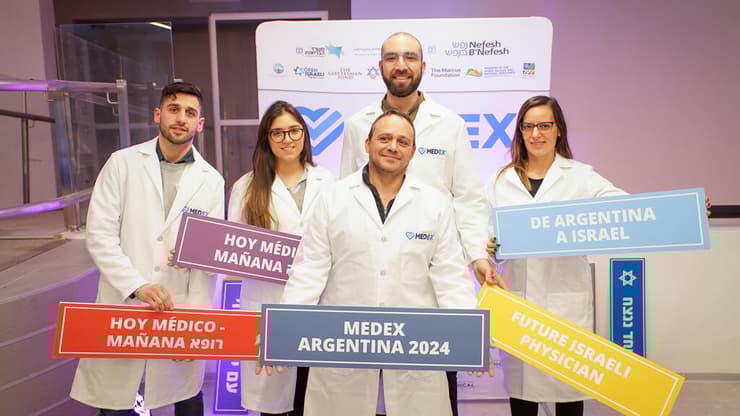
“Doctors planning Aliyah at MedEx Argentina in July 2024”
(צילום: Martin Roisman)
Are there new Olim who are having second thoughts about making Aliyah due to the war?
"None at all. On the contrary, some made Aliyah despite the war and many because of it, but they were fully aware of the challenges. During this time, they’ve experienced an even deeper sense of belonging, enthusiasm, and unity. They’ve integrated into the community and culture and have found their place here. Tragically, some of our Olim lost sons and daughters in the war which was devastating to us all’".
Which achievements from the past year are you especially proud of?
"After the initial delay, we are tremendously proud to have launched the International Medical Aliyah Program (IMAP), a national initiative facilitating the Aliyah of physicians from around the world, in partnership with the Ministry of Aliyah and Integration, the Ministry of Health, and the Jewish Agency for Israel. Despite the challenges, we successfully introduced the program in cities across the globe, including Paris, London, New Jersey, and Buenos Aires. Our MedEx fairs have been instrumental in streamlining the Aliyah process and assisting doctors with medical licensing and integration into the Israeli healthcare system– truly the realization of a dream.
"The Jews in the Diaspora have shown remarkable support and feel a connection to the State of Israel in ways we haven't seen in a long time. This solidarity is expressed in a variety of ways, such as donations and marches in support of Israel. Throughout all these events, I didn’t encounter a single Jew in the Diaspora questioning the promotion of Israel, even in the midst of a war. The importance of Aliyah is clear to everyone, even during the current situation".
What have you learned this past year?
"People have shown that they are capable of far more than they ever imagined. In times of war, you come to cherish every moment of beauty and positivity around you. If you have the ability to contribute positivity, seize the opportunity and give it your all. You’ll find that, when you try, you have far more resources and hidden reserves of strength than you ever realized".
Where do you see the organization in a year?
"We are in the midst of a transition period in which we are taking on the development of new national initiatives. We are currently expanding services for Lone Soldier Olim, strengthening connections and relationships with their parents, and establishing a dedicated multilingual support team to assist them.
"In addition, we are entering the field of mental health treatment. We already see the impact of the war on the soldiers, and we have the privilege and honor to step into this essential space with partners such as FIDF (Friends of Israel Defense Forces), Sheba Medical Center and other leading institutions.
"Our relationships with government ministries and national institutions are stronger than ever. We are finding the balance between operating at the level of a national institution while remaining an independent nonprofit organization. I believe this is the next chapter for the organization".