
Two years after the October 7th terrorist attack, Yehuda Setton finds himself leading The Jewish Agency for Israel through one of the most fateful times in history. This venerable 100-year-old institution, which for decades focused on Aliyah and connecting Jewish communities around the world, suddenly had to adapt its strategy to a new reality—full of upheavals and crises.
“The war marked a turning point", Setton says. “We realized that we couldn’t continue to operate only according to existing plans. Our vision is not only to restore what was destroyed, but also to rebuild the future. That’s why we decided to be at the forefront of civilian resilience—to go out into the field, to be with the citizens, to help everyone affected, to extend a hand to the state, and to be wherever it needs us".
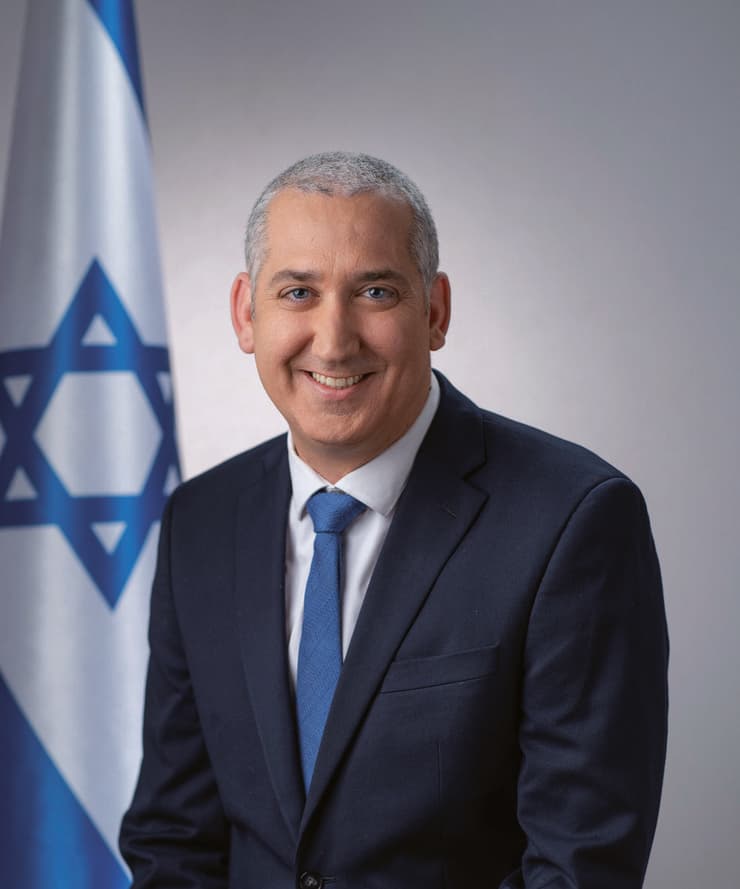
Yehuda Setton
(צילום: Dudi Salam, a production couple for the Jewish Agency)
Since then, in close cooperation with The Jewish Federations of North America, Keren Hayesod, World Zionist Organization and the Israeli government, The Jewish Agency’s activity has expanded on an unprecedented scale: supporting over 22,000 families of victims of war and terror, assisting 15,000 small businesses, creating 30 new partnerships between southern and northern towns and Jewish communities worldwide, sending thousands of youths from these regions to summer camps in North America, and launching a program to build about 1,000 housing units in the Western Negev. More than 46,000 new immigrants have arrived in Israel since the war began, with the help of the Ministry of Aliyah and Integration and The Jewish Agency.
“Our great achievement is that we managed to turn a historic crisis into a moment of collective action", says Setton. “And we did so immediately—by opening a command center, building scenarios, collecting data, and all while caring for our thousands of employees in Israel and around the world".
Sounds challenging, especially in light of your ongoing activities over the years.
"Emergency situations are not foreign to the Jewish Agency, and we have always been involved with them. In every such event, we activate our control center, with organized technological systems and tracking capabilities. We were there for Israeli citizens, for the Jewish people worldwide, and of course also for our employees. But at a certain point, a year into the war, we understood that the emergency could no longer manage us. We had to integrate emergency with routine.
We mapped out the situation and its needs, looked for a way to provide a holistic and flexible response, one capable of going from zero to a hundred in a second. We have 20,000 people who depend on us – olim, youth, volunteers and others. How do we respond to their changing needs? This is where the greatness of The Jewish Agency lies: the ability to adjust to a changing reality, while remaining focused on the objective, from support to advocacy, and to provide immediate response alongside long-term building".
Since the outbreak of the war, The Jewish Agency has led extensive programs for the rehabilitation of the south and north, supported populations affected by terror and war, and even established the Rising Lion Fund to assist families affected by missile fire from Iran. During nerve-wracking days, Setton managed to bring the CEOs of the major North America Federations to France, to hear up close about the challenges of Jewish communities in Europe. From there he invited them to come to Israel – and they all came. Just days after the end of the war, he was already standing with them on the ruins in Bat Yam, his childhood city, after an Iranian missile hit the neighborhood. The most senior leaders in the Jewish world found themselves standing beside him facing the destruction – and returned to their homes with a clear commitment to continue supporting Israel.
‘A New Perspective’
After 16 years of serving in various roles at The Jewish Agency, Setton was appointed CEO and director general at the age of just 42—the youngest to hold the position in the organization’s history.
“I understand the weight of the responsibility and am aware that many eyes are watching me", he says. “Being a young CEO means coming with humility, listening a lot, but also bringing a new perspective".
He continues, “I come with the mindset of the younger generation—a generation that lives at a different pace, thinks digitally, speaks directly, and is unafraid of change. This allows me to connect the Agency to the language of the young, introduce new dynamics, and be open to experimentation and learning. Of course, none of this replaces the immense weight of history—rather, it comes alongside the duty to connect heritage to the future".
Setton also mentions his grandmother, who was brought to Israel in The Jewish Agency’s “Tehran Children” operation. “For me, this is full circle. The organization that saved my grandmother now leads the future of my children. This is truly a mission".
Relevance and Legacy
How does The Jewish Agency manage to remain relevant throughout history?
“The Jewish Agency is not a government authority. We don’t have a fixed budget, and every year we start from zero", Setton explains. “This means our responsibility is doubled: not only to do what we believe is right but also to prove to the Jewish people that we are relevant and that they should continue to support us.
“The world is divided into two types of organizations: those whose goal is profit and those whose goal is impact. If we don’t generate meaningful impact, we have no right to exist. And if The Jewish Agency didn’t exist—it would have to be invented".
According to Setton, the organization’s relevance stems from its tangible impact on people’s lives. “When I had the privilege of leading the rescue operation from Ukraine, I was once again reminded of how vital this organization is. We changed people’s lives, and we did it together with the Jewish people and the State of Israel. One day, a book will be written about our employees—true heroes of everyday life".
At any given moment, someone is acting on behalf of The Jewish Agency for the Jewish people. On this frontline stand 3,000 Shlichim (Israeli emissaries) in 65 countries—many of them from the TikTok generation—who bring Israel into discourse on campuses, in WhatsApp groups, and across social media.
“We invest in content, online presence, and digital tools, but we know that real relevance is created when we change lives: When we provide protection to communities in France, when a young American meets a shaliach who sparks pride in his identity, or when a family makes Aliyah in the middle of a war", Setton says. “These are the moments that prove again why we are here".
Looking Ahead
How does Setton see the management of The Jewish Agency evolving in the coming years?
“The Jewish Agency must become the champion of joint action by the Jewish people in Israel and the Jewish communities abroad. Our mission touches on development, rehabilitation, and building of the state, supporting populations affected by crises, and strengthening the sense of Jewish identity and mutual responsibility here and around the world.
“We need to become the leading technological body among organizations with impact-driven goals. A technological revolution is the way to become more efficient and increase our influence—and we are investing significant resources in this".
He emphasizes the importance of having “inspired leadership and the most talented people whose hearts are in the right place, led by our Chairman of the Board of Governors, Mark Wilf and Chairman of the Executive, Maj, Gen. (res.) Doron Almong. They enable us to operate at business standards that rival any other body".
“We will achieve our goals if we succeed in bringing significant Aliyah to Israel, expanding the network of Shlichim, and helping to build resilience", Setton says. “Our vision is of an Israeli and Jewish generation with a sense of shared ownership—a generation that understands the Jewish people are a collective asset. If we succeed, Israel will be a more stable state, and the Jewish people will move toward a more connected, united, and innovative future".